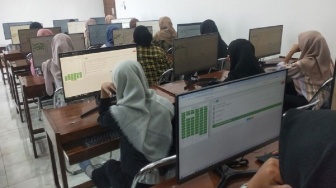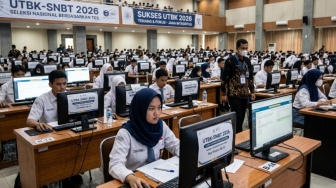





- Pelajar yang tidak lolos SNBP 2026 dapat mengikuti jalur SNBT yang mencakup Tes Potensi Skolastik dan Tes Literasi.
- Materi ujian tersebut meliputi berbagai bidang, seperti penalaran umum, literasi bahasa, pengetahuan kuantitatif, hingga kemampuan menulis dan membaca.
- Ujian ini bertujuan menguji kompetensi akademik siswa sebagai syarat seleksi masuk perguruan tinggi negeri yang dilaksanakan secara nasional.
SuaraBali.id - Bagi pelajar yang tidak berhasil lolos Perguruan Tinggi Negeri (PTN) melalui jalur SNBP 2026, masih ada kesempatan untuk mencoba jalur SNBT.
Materi tes dalam Ujian Tertulis Berbasis Komputer (UTBK) SNBT 2026 terdiri atas dua komponen, yaitu Tes Potensi Skolastik dan Tes Literasi.
Dalam Tes Potensi Skolastik dan Tes Literasi ini terbagi lagi menjadi beberapa jenis tes, diantaranya yakni Penalaran Umum, Pengetahuan dan Pemahaman Umum, Kemampuan Memahami Bacaan dan Menulis, Pengetahuan Kuantitatif, Literasi dalam Bahasa Indonesia, Literasi dalam Bahasa Inggris hingga Penalaran Matematika.
Berikut contoh soal Literasi Bahasa Inggris SNBT yang pernah muncul:
Baca Juga:Tata Tertib UTBK SNBT 2026 Wajib Dipatuhi agar Ujian Lancar
1. Text 3
Nuclear physicists have achieved a major milestone in fusion energy. Unlike current nuclear power plants, fusion generates energy by joining atoms together rather than splitting them. This process mimics the sun's core and produces no long-lived radioactive waste. Researchers believe this could provide a near-limitless source of clean energy. The new experiment used powerful magnets to turn hydrogen gas into a plasma hotter than the sun. For example, if a traditional plant produces 500 megawatts, a fusion reactor could theoretically produce ten times that amount with minimal fuel.
The reactor operates using 'magnetic confinement.' Instead of solid walls, the superheated plasma is held in place by invisible magnetic fields. This prevents the plasma from touching the reactor's interior and cooling down. This process is known as steady-state fusion. The lead physicist stated they want to replace coal plants with fusion centers by 2050. Their prototype uses a 'tokamak' design, improved with superconducting magnets, which can be operated for long durations.
This technology is often called 'artificial sun' research. It creates energy by fusing isotopes like deuterium and tritium. These elements are found in seawater and lithium, making the fuel source abundant. The international team plans to build a commercial-scale plant to demonstrate its safety and efficiency.
As the climate crisis worsens, decarbonizing the energy grid is mandatory. Fusion energy is a critical part of a sustainable future. This technology uses small amounts of fuel to sustain massive electrical output. It could be integrated into existing grids to power entire nations without carbon emissions.
Text 4
The fusion effect occurs when two light atomic nuclei combine to form a single heavier one. It is like two droplets of water merging into one, releasing a massive burst of energy in the process. When nuclei fuse, they lose a tiny amount of mass which is converted into heat. This allows the reactor to generate power without the risk of a meltdown. This reaction is much harder to achieve than fission because it requires extreme heat.
Baca Juga:Kunci Jawaban Soal SNBT: Penalaran Umum 2
Fusion devices, or tokamaks, use this effect to create power. They utilize high-frequency radio waves to heat the plasma to millions of degrees. Tokamaks can change a simple gas into a spinning ring of energy. These devices are built with heavy shielding and cooling systems. When the magnetic fields stabilize the plasma and the atoms collide, they create a self-sustaining heat source that can be harnessed for electricity.
Fusion systems have many benefits. They can turn seawater into a virtually inexhaustible fuel supply. Tokamaks can also provide a stable energy source that doesn't depend on the weather. By controlling the magnetic fields, they can maintain the reaction safely for hours at a time.
This technology allows for 'fail-safe' energy production. The use of fusion reactors can eliminate the risk of nuclear accidents associated with fission. Furthermore, this means eliminating the problem of storing radioactive waste for thousands of years.
Information regarding the safety of fusion compared to fission can be found in . . .
A. Text 3 Paragraph 1 and Text 4 Paragraph 1
B. Text 3 Paragraph 2 and Text 4 Paragraph 2
C. Text 3 Paragraph 4 and Text 4 Paragraph 4
D. Text 3 Paragraph 3 and Text 4 Paragraph 1
E. Text 3 Paragraph 2 and Text 4 Paragraph 3
Jawaban:
C. Text 3 Paragraph 4 and Text 4 Paragraph 4
Pembahasan:
· Opsi A: Teks 3 Paragraf 1 menyebutkan perbedaan proses (penggabungan vs pembelahan) dan limbah, namun Teks 4 Paragraf 1 lebih fokus pada penjelasan fisik proses fusi dan risiko pelelehan (meltdown) secara umum tanpa perbandingan mendalam di paragraf tersebut.
· Opsi B: Teks 3 Paragraf 2 dan Teks 4 Paragraf 2 berfokus pada aspek teknis operasional reaktor, seperti penggunaan magnet (magnetic confinement), desain tokamak, dan gelombang radio frekuensi tinggi.
· Opsi C: Teks 3 Paragraf 4 memberikan konteks keberlanjutan masa depan, dan Teks 4 Paragraf 4 memberikan perbandingan keamanan paling eksplisit antara fusi dan fisi, termasuk risiko kecelakaan dan masalah limbah jangka panjang.
· Opsi D: Teks 3 Paragraf 3 membahas sumber bahan bakar (isotop dari air laut), dan Teks 4 Paragraf 1 membahas mekanisme dasar penggabungan inti atom.
· Opsi E: Teks 3 Paragraf 2 membahas desain teknis reaktor, dan Teks 4 Paragraf 3 membahas stabilitas pasokan bahan bakar yang tidak bergantung pada cuaca.
Berdasarkan analisis tersebut, pasangan paragraf yang paling tepat memberikan informasi mengenai perbandingan keamanan fusi terhadap fisi adalah paragraf penutup dari kedua teks tersebut, di mana aspek manfaat dan keamanan jangka panjang dirangkum.
2. Text 1
In the labs of sustainable startups, scientists are cultivating a new material that looks and feels like leather but is grown from fungi. Known as 'mycelium leather,' this bio-fabricated material uses the root structure of mushrooms as its base. Unlike traditional leather, it requires no livestock and uses significantly less water. ”Working with living organisms allows us to grow products to specific shapes,” said a lead researcher. For many designers, mycelium is a revolutionary answer to the ethical and environmental costs of the fashion industry. ”It is a symbiotic relationship between design and biology that yields zero waste.”
The decision to shift to mycelium initially came from a matter of urgency regarding carbon footprints, but it has now become a standard for luxury brands. ”We spent decades refining synthetic leather, but it was just plastic,” the designer noted. ”When we embraced mycelium, we found a material that breathes and ages like the real thing.” They discovered that fungal structures were far more durable than expected. ”I had never seen a material that could be so strong yet entirely biodegradable in a backyard compost.”
Text 2
When a digital-only dress—essentially a series of pixels—sold for USD9,500 in 2019, it sparked a debate about the value of 'possessions' in the digital age. Digital fashion, often sold as NFTs, allows users to 'wear' high-end couture in photos and virtual worlds without a physical item ever being made. Critics argue this is a symptom of extreme consumerism and vanity. I doubt that digital clothing will ever replace the fundamental need for physical protection.
For their money, the buyer receives a 3D file and a certificate of ownership on the blockchain. There is no fabric to wash, no size to outgrow, and no carbon emission from manufacturing. ”It is the ultimate solution to fast-fashion waste,” a digital designer claimed. Unlike physical clothing, digital items can be sold and traded instantly across the globe. However, they only exist as long as the server hosting them remains active.
The rise of the Metaverse has pushed luxury houses like Gucci and Balenciaga to release virtual collections. The original designs are often 'minted' in limited quantities, though the artist can create infinite copies at the click of a button.
Which of the following is the best synthesis of the two texts?
A. Both leathers and pixels are becoming very expensive
B. Text 1 focuses on bio-materials while Text 2 on virtuality
C. Blockchain is used to grow mushrooms in laboratory settings
D. Both authors agree that fast fashion is beneficial
E. Luxury brands are avoiding both sustainable and virtual trends
Jawaban:
B. Text 1 focuses on bio-materials while Text 2 on virtuality
Pembahasan:
· Opsi A salah karena meskipun Text 2 menyebutkan harga yang mahal, fokus utama kedua teks bukan pada kenaikan harga, melainkan pada inovasi material dan teknologi.
· Opsi B benar karena secara akurat merangkum fokus masing-masing teks, yaitu Text 1 pada bio-materials (mycelium) dan Text 2 pada virtuality (digital fashion).
· Opsi C salah karena mencampuradukkan informasi; blockchain digunakan dalam konteks busana digital di Text 2, bukan untuk menumbuhkan jamur di Text 1.
· Opsi D salah karena kedua teks justru memposisikan inovasi tersebut sebagai solusi untuk mengatasi masalah limbah yang dihasilkan oleh fast fashion, bukan mendukungnya.
· Opsi E salah karena kedua teks secara eksplisit menyebutkan bahwa merek-merek mewah (luxury brands) justru mulai mengadopsi dan merangkul tren berkelanjutan serta virtual tersebut.
3. Questions 3 to 4 refer to the following forum thread:
a. Apollo 10 – 03 – 2025
The rise of 'Influencer Culture' has blurred the line between genuine recommendation and paid advertisement. While it provides a platform for creativity, it often promotes an unattainable lifestyle through filtered realities. You must be aware that following curated lives can distort your perception of personal success. How do you maintain authenticity in your digital interactions?
b. Vesta 11 – 03 – 2025
I’ve started unfollowing accounts that only show 'perfect' moments. I now prioritize following creators who share their failures and daily struggles. It was difficult to let go of the aesthetic feeds, but I feel much less pressure to compete with strangers now.
c. Diana 12 – 03 – 2025
For me, as a small creator, honesty is my primary rule. I only accept sponsorships if I have used the product for at least thirty days. If a brand asks me to hide the negatives, I decline the offer. It’s a slower way to grow, but my audience trusts me more.
d. Mars 14 – 03 – 2025
The problem is that the algorithm favors controversy over truth. I’ve started using a browser extension called 'AdCheck' that highlights whenever a post is a hidden advertisement. It helps me see through the 'natural' looking posts that are actually sales pitches.
e. Minerva 16 – 03 – 2025
Thanks for this! I’ve decided to limit my social media use to just one hour a day. I realized I was subconsciously mimicking the habits of influencers I didn't even like. Stepping away has helped me rediscover my own interests without digital influence.
f. Vulcan 19 – 03 – 2025
We need stricter 'Transparency Laws' for social media platforms. Currently, many influencers hide their 'AD' tags in a sea of hashtags. I’m advocating for standardized labels that are impossible to miss, so consumers always know when they are being sold something.
Which of the following issues is primarily raised by Apollo at the start of the thread?
A. The technical errors in digital tracking apps
B. The erosion of authenticity in influencer culture
C. The lack of high-speed internet in rural areas
D. The difficulty of finding honest brand deals
E. The health risks of using social media apps
Jawaban:
B. The erosion of authenticity in influencer culture
Pembahasan:
Opsi A tidak tepat karena teks tersebut sama sekali tidak membahas mengenai kesalahan teknis atau galat pada aplikasi pelacakan digital.
Opsi B tepat karena mencerminkan poin utama Apollo mengenai bagaimana budaya influencer merusak batasan antara kejujuran dan iklan, serta dampaknya terhadap persepsi keaslian hidup.
Opsi C tidak tepat karena isu infrastruktur internet atau kecepatan koneksi di pedesaan tidak disebutkan dalam diskusi tersebut.
Opsi D tidak tepat karena meskipun kejujuran dalam kerja sama merek dibahas oleh Diana, fokus utama Apollo di awal utas adalah dampak budaya tersebut secara umum terhadap audiens, bukan kesulitan teknis mencari kontrak iklan.
Opsi E tidak tepat karena Apollo lebih menekankan pada aspek persepsi sosial dan keaslian konten daripada risiko kesehatan medis secara spesifik.
4. Questions 3 to 4 refer to the following forum thread:
a. Apollo 10 – 03 – 2025
The rise of 'Influencer Culture' has blurred the line between genuine recommendation and paid advertisement. While it provides a platform for creativity, it often promotes an unattainable lifestyle through filtered realities. You must be aware that following curated lives can distort your perception of personal success. How do you maintain authenticity in your digital interactions?
b. Vesta 11 – 03 – 2025
I’ve started unfollowing accounts that only show 'perfect' moments. I now prioritize following creators who share their failures and daily struggles. It was difficult to let go of the aesthetic feeds, but I feel much less pressure to compete with strangers now.
c. Diana 12 – 03 – 2025
For me, as a small creator, honesty is my primary rule. I only accept sponsorships if I have used the product for at least thirty days. If a brand asks me to hide the negatives, I decline the offer. It’s a slower way to grow, but my audience trusts me more.
d. Mars 14 – 03 – 2025
The problem is that the algorithm favors controversy over truth. I’ve started using a browser extension called 'AdCheck' that highlights whenever a post is a hidden advertisement. It helps me see through the 'natural' looking posts that are actually sales pitches.
e. Minerva 16 – 03 – 2025
Thanks for this! I’ve decided to limit my social media use to just one hour a day. I realized I was subconsciously mimicking the habits of influencers I didn't even like. Stepping away has helped me rediscover my own interests without digital influence.
f. Vulcan 19 – 03 – 2025
We need stricter 'Transparency Laws' for social media platforms. Currently, many influencers hide their 'AD' tags in a sea of hashtags. I’m advocating for standardized labels that are impossible to miss, so consumers always know when they are being sold something.
Who provided evidence that digital distancing can help a person regain their individual identity?
A. Vesta
B. Diana
C. Mars
D. Minerva
E. Vulcan
Jawaban:
D. Minerva
Pembahasan:
· Vesta berfokus pada kurasi konten dengan berhenti mengikuti akun-akun yang tampak sempurna dan beralih ke konten yang lebih realistis untuk mengurangi tekanan mental, namun tidak secara spesifik membahas pembatasan waktu penggunaan atau penemuan kembali identitas diri melalui jarak digital.
· Diana memberikan perspektif sebagai pembuat konten kecil yang mengutamakan kejujuran dan integritas dalam menerima sponsor demi kepercayaan audiens.
· Mars membahas solusi teknis berupa penggunaan ekstensi browser untuk mendeteksi iklan tersembunyi agar tidak terjebak oleh taktik pemasaran.
· Minerva secara eksplisit menyebutkan tindakan membatasi waktu penggunaan media sosial (distancing) dan hasil positifnya dalam menemukan kembali jati diri dan minat pribadinya.
· Vulcan lebih fokus pada aspek regulasi dan hukum, di mana dia menyuarakan perlunya transparansi iklan yang lebih ketat di platform media sosial.
5. TEXT 1
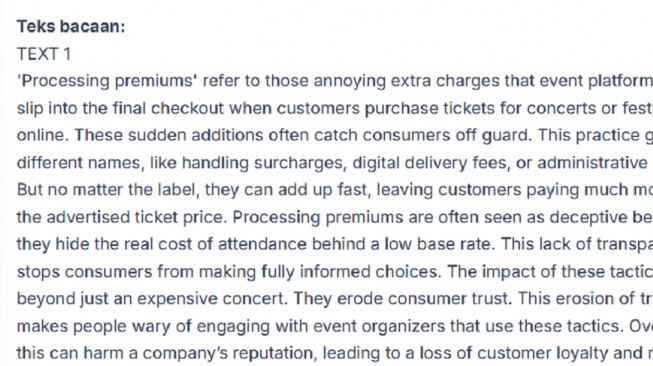
'Processing premiums' refer to those annoying extra charges that event platforms often slip into the final checkout when customers purchase tickets for concerts or festivals online. These sudden additions often catch consumers off guard. This practice goes by different names, like handling surcharges, digital delivery fees, or administrative markups. But no matter the label, they can add up fast, leaving customers paying much more than the advertised ticket price. Processing premiums are often seen as deceptive because they hide the real cost of attendance behind a low base rate. This lack of transparency stops consumers from making fully informed choices. The impact of these tactics goes beyond just an expensive concert. They erode consumer trust. This erosion of trust in turn makes people wary of engaging with event organizers that use these tactics. Over time, this can harm a company’s reputation, leading to a loss of customer loyalty and negative social reviews. Regulators have responded, with consumer protection agencies now considering whether to require businesses to clearly state all mandatory fees upfront in the initial offer. Companies that fail to maintain honesty can face heavy fines and legal bans, adding more risk to this practice. From an ethical standpoint, processing premiums raise serious questions. They often impact young fans the most. Unfortunately, these vulnerable consumers are those who may struggle with navigating hidden digital costs. To build and keep trust, companies are encouraged to be clear and open about charges. By following ethical pricing practices, brands can build lasting relationships with consumers. This approach helps protect their reputation and makes them stand out in a marketplace where honesty and clarity are valued more than ever.
TEXT 2
Since August 1, 2026, the 'Event Transparency Initiative' (ETI) has been enforced in several regions. This new law bans hidden charges for essential live entertainment services. This is good news. It takes aim at ”price-stacking,” where businesses advertise a low rate but add mandatory fees during the final click. Now, businesses must show the total cost, including all processing and facility fees, on the first selection screen. Nevertheless, optional VIP parking and certain merchandise add-ons are exempted. Guidance from the Attorney General’s office clarifies that advertised prices must reflect the actual final cost consumers will support. For instance, a service fee must be part of the base rate, but insurance can be separate. Apps must include clear fee-breakdown charts in their digital confirmations. ETI prevents businesses from tricking fans at the point of purchase. However, it does not restrict them from using varied colors if they keep the transparency consistent.
Acco
The phrase consumer trust in Text 1 Paragraph 2 is closest in meaning to . . .
A. Customer faith
B. Buyer awareness
C. Client confidence
D. Client expectation
E. Customer credibility
Jawaban:
C. Client confidence
Pembahasan:
· Customer faith: Meskipun "faith" berarti kepercayaan, kata ini sering kali mengandung konotasi keyakinan yang sangat mendalam atau bersifat religius, sehingga kurang umum digunakan dalam konteks transaksi komersial formal dibandingkan dengan "confidence".
· Buyer awareness: Istilah ini merujuk pada kesadaran atau pengetahuan pembeli mengenai keberadaan produk atau praktik pasar tertentu, bukan mengenai rasa percaya mereka terhadap perusahaan.
· Client confidence: Ini adalah sinonim yang paling tepat. Kata "client" merupakan padanan untuk "consumer" dalam konteks layanan, dan "confidence" secara spesifik menggambarkan perasaan percaya atau keyakinan bahwa suatu pihak akan bertindak dengan jujur dan kompeten.
· Client expectation: Istilah ini merujuk pada ekspektasi atau apa yang diharapkan klien akan mereka terima, yang belum tentu mencerminkan rasa percaya atau hubungan emosional terhadap integritas perusahaan.
· Customer credibility: Kredibilitas merujuk pada kualitas atau reputasi perusahaan yang membuatnya layak dipercaya (objek), sedangkan "trust" adalah perasaan percaya yang dirasakan oleh pelanggan (subjek).
Berdasarkan analisis tersebut, client confidence memiliki makna yang paling dekat dengan consumer trust karena keduanya menekankan pada aspek keyakinan pelanggan terhadap penyedia layanan.
Kontributor : Kanita